Essays · For people who left church
Outside the Door
When they threw a man out, I went and found him.
For people who left church Written for people who have left church, or are halfway out the door. Coming from somewhere else? Find the essay for you.
Words to Know
The nones — the name researchers use for people who, asked their religion, answer none. In the United States they are now close to three in ten adults.1
Deconstruction — taking apart, piece by piece, the faith you were raised in, to see which parts hold. The word comes from philosophy, but most people who use it now mean something simpler: asking the questions you were not allowed to ask.
Exvangelical — a word coined in the 2010s by people who left evangelical churches, for themselves.2
Spiritual but not religious — the phrase many people use for believing in something, or hoping for something, without belonging to a church.
Start with the man they threw out.
There is a story in the Gospel of John about a man who had been blind from birth. I put mud on his eyes and told him to wash, and he came back seeing. That should have been the end of it. Instead the religious authorities questioned him, then questioned his parents, then questioned him again. When he would not say what they wanted, they threw him out (John 9:34).
Here is the next sentence: Jesus heard that they had thrown him out, and finding him, he said, “Do you believe in the Son of God?” (John 9:35).
I went and found him. Not at the synagogue. Outside it.
You should know two things about that story. The Gospel of John was written late, and many scholars think the expulsions it describes reflect the hard years after the Temple fell, when my followers and the synagogues were parting ways.3 Do not hear it as a story about Jews. It is a story about what any religious institution can do to a person who will not repeat its lines, and about where I was when it happened.
If you have left church, you are in very large company. In 2020, for the first time since Gallup began asking in 1937, fewer than half of Americans said they belonged to a church, a synagogue or a mosque.4 When researchers ask people with no religion why, the most common answer is that they question a lot of religious teachings. Many also say they dislike religious organizations or the positions churches take on social and political questions, and three in ten point to bad experiences with religious people.1
This essay is not here to talk you into going back. It is here to tell you three things. You were not wrong to notice what you noticed. Much of what you left was never mine. And I am still outside the door, where they threw the man out.
You Were Not Wrong to Notice
You may have been told that leaving was a failure of faith. Some of it may have been a success of conscience.
My harshest words were not for the people outside religion. They were for the people running it. I said of the religious leaders of my own day: they bind heavy burdens that are grievous to be borne, and lay them on men’s shoulders; but they themselves will not lift a finger to help them (Matthew 23:4). I called them whitened tombs, which outwardly appear beautiful, but inwardly are full of dead men’s bones (Matthew 23:27). I said those things to teachers of my own people, inside my own tradition, and they are a warning to every religion, including the ones that carry my name.
When I saw religious men more concerned with a rule than with a man’s withered hand, Mark says that I looked around at them with anger, being grieved at the hardening of their hearts (Mark 3:5). If you have been angry at what you saw in church, you were angry at something I was angry at too.
You may have noticed that the church that told you to love your neighbor voted against your neighbor. That the preacher who talked about humility flew in a private jet. That the people who taught you about grace had none for your questions, or for your friend who came out, or for you. That a man who hurt children was moved quietly to another parish, or another state. That the flag stood next to the cross, and nobody seemed to find that strange.
Noticing is not losing your faith. It is often the first honest thing a person does with it.
Much of What You Left Was Never Mine
You may think you walked away from me. Look at what you actually walked away from.
The book these essays come from, The Lessons of Jesus, keeps an audit: a list of the things that were added to my teaching after I died, with the date each arrived where a date can be given.5 Here are some of them, and a few more that its lessons trace.
Hell as a place of endless torture, which took shape over centuries and is not what the word Gehenna meant to the people I spoke to. A theory that God needed to be paid before he could forgive, set out about a thousand years after me. The claim that the original text of the Bible has no errors of any kind, in its modern form from 1881. The rapture, in the form most people know, from the 1830s. The sinner’s prayer as a set formula, which grew out of nineteenth-century revivals and reached print in the early twentieth century. The prosperity gospel, from the twentieth century. The flag in the sanctuary.6
If you left a church because you could not believe that a loving God would burn your grandmother forever, you did not leave me. You left an addition. If you left because the church was more interested in a party or a nation than in the poor, you left an addition. If you left because a man at the front had made himself the master, you left something I forbade: one is your teacher, the Christ, and all of you are brothers (Matthew 23:8).
People have done this before you. Leo Tolstoy, the great Russian novelist, was cut off by the Russian Orthodox Church in 1901. The Synod named his denial of the Trinity, of my divinity and of the church’s sacraments. He had also spent years writing that my Sermon on the Mount meant exactly what it said, that no one should take up arms or take an oath or resist evil with violence.7 His book on it, The Kingdom of God Is Within You, was read by a young lawyer in South Africa named Mohandas Gandhi, a Hindu who never joined a church. He said it overwhelmed him.8 Thomas Jefferson took a razor to the gospels, cut out my teachings to keep them by themselves, and left the miracles and the resurrection behind.9 None of them found what they were looking for inside the institutions. All of them kept the teacher.
Much of What I Said Is Still Yours
You do not need a building, a membership or a creed to do what I asked.
A woman once asked me which mountain was the right place to worship. I told her: the hour comes, when neither in this mountain, nor in Jerusalem, will you worship the Father (John 4:21). I said that where two or three are gathered together in my name, there I am in the middle of them (Matthew 18:20). The first gatherings of my followers met in people’s houses. Paul ends one of his letters by greeting the assembly that is in their house (Romans 16:5).
And in my story of the last judgment, the people who fed the hungry and visited the prisoners did not know that they had been serving me. They were surprised. They asked, Lord, when did we see you hungry, and feed you? (Matthew 25:37). They were not asked what they believed, or where they worshipped, or whether they had been to church. They were asked whether they had stopped.
When a lawyer asked me who his neighbor was, I told him about a man beaten and left on the road. A priest saw him and passed by on the other side. So did a Levite, a Temple servant (Luke 10:31–32). The one who stopped was a Samaritan, a man from the people the lawyer had been taught to despise, with the wrong mountain and the wrong beliefs. I asked which of the three was a neighbor. The lawyer said, He who showed mercy on him. And I said: Go and do likewise (Luke 10:36–37).
The two religious men were on their way somewhere. The man with the wrong religion stopped. That story is yours whether you ever set foot in a church again.
What You’ll Hear Back
If you tell the people who love you that you have left, they will have answers ready. Most of them are afraid for you. Here are the six you will hear most, and what is underneath each one.
“You’re backsliding. You’re going to hell.”
They were taught to be afraid of that, and they are afraid for you. The Lessons of Jesus tells, in Lesson 21, how the idea of endless torment grew, and how far it is from what I meant. And remember where I went when a man was thrown out: I went looking for him (John 9:35). I told a story about a shepherd who leaves ninety-nine sheep to find one, and carries it on his shoulders, rejoicing (Luke 15:4–5). I do not wait inside for the lost to come crawling back.
“You were never really saved.”
That sentence comes from a teaching that a true believer cannot finally fall away, so anyone who does must never have been one. It lets them keep their system intact by deciding that you never really belonged to it. I said: Don’t judge, so that you won’t be judged (Matthew 7:1).
“You’re just angry at God.”
You may be angry at what was done in God’s name. That is not the same thing. I was angry at it too. I turned over the tables in the Temple (Mark 11:15), and I looked at hard-hearted religious men with anger (Mark 3:5). Anger at injustice dressed up as religion is one of the most religious things there is.
“You need a church family.”
You do need people. I never asked anyone to follow me alone; I gathered friends, and we ate together. But the family I made was not defined by a building. When I was told my mother and brothers were outside, I looked at the people around me and said: whoever does the will of God is my brother, my sister, and mother (Mark 3:35). Look for the people who are feeding the hungry and sitting with the sick. Some of them are in churches. Some are not. That is your family.
“Don’t throw the baby out with the bathwater.”
That is good advice, and it is the whole reason these books exist. Throw out the bathwater: the additions, the fear, the flag, the jet. Keep the baby. The baby is a teacher who said Blessed are you who are poor (Luke 6:20), love your enemies (Luke 6:27), and Come to me, all you who labor and are heavily burdened, and I will give you rest (Matthew 11:28).
“The church isn’t perfect, because people aren’t perfect.”
That is true, and if all you had seen were imperfect people, it would be a fair answer. But some of what you saw was not a person failing. It was a teaching, or a decision made at the top: to hide an abuser, to cast someone out, to bless a war, to sell a promise. You were right to leave those. Leaving them was not a failure to forgive imperfection. It was a refusal to call wrong things right.
If You Were Hurt by It
Some of you did not just drift away. You were pushed. You were told you were going to hell for asking a question, or for who you love, or for being a woman who wanted to speak. You were shamed in front of a congregation, or shunned by your own family, or hurt by a man who held a title and used my name to keep you quiet.
That was not me. I was the one outside the door.
You do not owe anyone a return. You do not have to forgive on anyone’s timetable, or sit in a room that hurt you, to be close to me. If you ever want to read my words again, start with the Sermon on the Mount, Matthew 5 to 7, and read it as if no one had ever explained it to you. Then read the story of the man born blind, all of John 9, to the end. Notice who went looking for whom.
And if you no longer believe any of it, if God is a question you have set down, you can still pick up the Samaritan’s work. It does not need your belief to be good. Go and do likewise (Luke 10:37).
Check It Yourself
Read John 9, the whole chapter. Write down who threw the man out, and who went looking for him.
Read Matthew 23:1–12 and 23:23–28. Write down who my harshest words were for.
Read Luke 10:25–37. Write down who passed by and who stopped.
Read Matthew 25:31–46. Write down what the people on my right hand were asked, and what they were not asked.
Read Matthew 11:28–30, then Matthew 23:4. Compare the two burdens.
Read the Sermon on the Mount, Matthew 5–7, in one sitting, without notes.
Look at the Audit at the back of The Lessons of Jesus (it is free at LessonsOfJesus.com). Mark which of the additions you were taught as if they were mine.
The Short Version
- When the authorities threw out the man born blind, I went and found him (John 9:35).
- In 2020, for the first time in Gallup’s records, fewer than half of Americans said they belonged to a congregation. You are in large company.
- People leave over questions, over what churches say and do in politics, and over harm. Noticing is not losing your faith.
- My harshest words were for religious leaders who lay heavy burdens on others and do not lift a finger.
- Much of what you left was added after me: endless hell, the payment theory, inerrancy, the rapture, the sinner’s prayer, the prosperity gospel, the flag.
- Tolstoy, Gandhi and Jefferson kept the teacher without the institution.
- I said worship would not belong to any mountain. Two or three, in a house, is enough.
- The people who served me in Matthew 25 did not know it was me. They were not asked what they believed.
- The neighbor in my story was the Samaritan, the man with the wrong religion, who stopped.
- If you were hurt in church, that was not me. You do not owe anyone a return.
Where to go from here
Every addition named in this essay has a longer history behind it, with sources. Start anywhere.
Three free books, in the same voice
Each one stands on its own. None of them asks for anything.
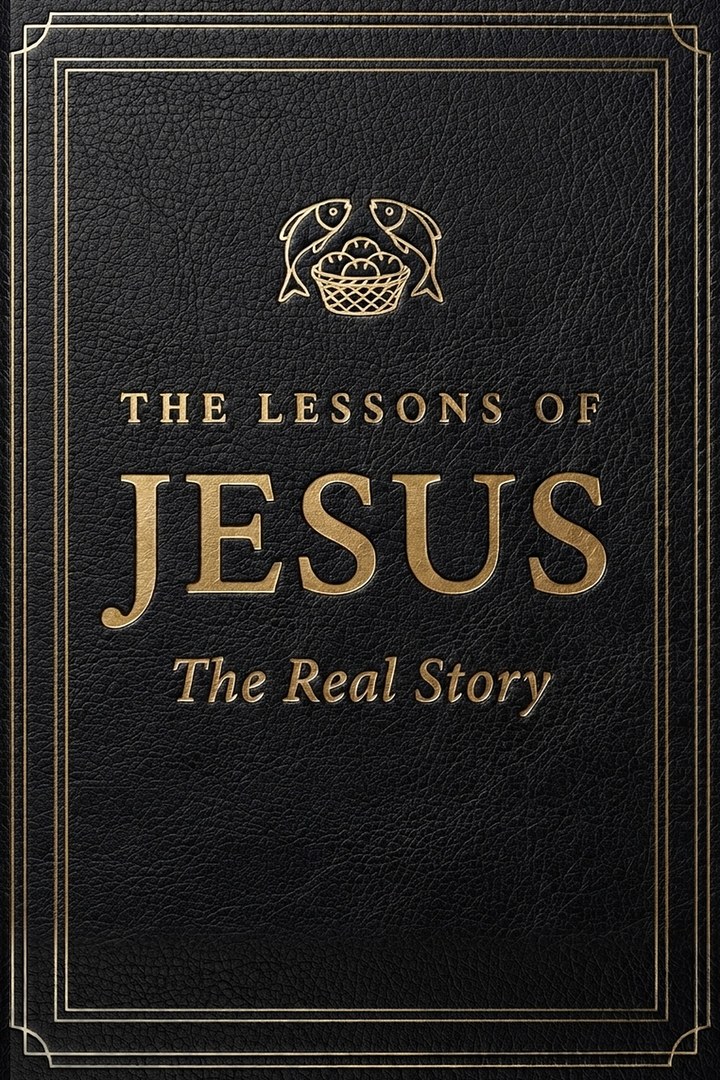 Book OneThe Real StoryForty lessons on what he taught, and what was built on top of it. Starts at Lesson 1.
 Book TwoUnderstanding the Old TestamentThe scriptures he grew up on, one chapter for every book.
 Book ThreeUnderstanding the New TestamentThe books written about him, one chapter for every book.
Sources for this essay
Every numbered note in the text points here, so nothing has to be taken on trust.
- Pew Research Center, Religious “Nones” in America: Who They Are and What They Believe (January 2024); about 28 percent of U.S. adults, and the reasons in chapter 2: 60 percent question religious teachings, 47 percent dislike religious organizations, 30 percent cite bad experiences with religious people. On the positions churches take on social and political issues (49 percent), see Pew, “Why America’s ‘nones’ don’t identify with a religion,” 8 August 2018. ↩
- On the word, coined as a hashtag by the writer and podcaster Blake Chastain in 2016, see Bradley Onishi, “The Rise of #Exvangelical,” Religion & Politics (2019), and Blake Chastain, Exvangelical and Beyond (TarcherPerigee, 2024). ↩
- J. Louis Martyn, History and Theology in the Fourth Gospel (1968; 3rd ed., Westminster John Knox, 2003). Many scholars now question parts of Martyn’s reconstruction, but the late date of John is widely accepted. ↩
- Jeffrey M. Jones, “U.S. Church Membership Falls Below Majority for First Time,” Gallup, 29 March 2021 (47 percent in 2020). ↩
- The Lessons of Jesus: The Real Story, the Audit, and LessonsOfJesus.com/audit. ↩
- On each of these, see The Lessons of Jesus, Lessons 13, 19, 21, 34, 35 and 36, and their sources. On the sinner’s prayer as a formula, see also Paul H. Chitwood, “The Sinner’s Prayer: An Historical and Theological Analysis” (PhD diss., Southern Baptist Theological Seminary, 2001). ↩
- The Holy Synod’s decree on Leo Tolstoy, 22 February 1901 (Old Style), and Tolstoy’s reply to it; his The Kingdom of God Is Within You (1894). ↩
- M. K. Gandhi, An Autobiography, or The Story of My Experiments with Truth (1927–1929), part 2, chapter 15. ↩
- Thomas Jefferson, The Life and Morals of Jesus of Nazareth (completed about 1820), now at the Smithsonian’s National Museum of American History. ↩